Books
The
How the Drug Discovery Industry Works course is
designed to cover the most important aspects of biopharmaceutical
R&D within a manageable time period. However, it is impossible to
cover the relevant subjects in great depth because of time
limitations and also because of the delegates’ varying levels of
prior knowledge. This has prompted PharmaGuide’s trainer Edward D.
Zanders to address this problem in the form of two books published
by Springer Nature as described below and in the publisher’s
description:
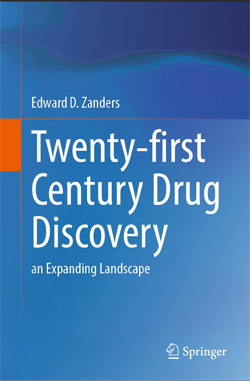
Twenty-first Century Drug Discovery-an Expanding
Landscape (
Springer
Nature link) follows on from the author’s
previous book
The Science and Business of Drug Discovery-Demystifying the Jargon published by Springer as a
second edition in 2020 (see below). While many of the key scientific
and commercial features of drug discovery described in the latter
are essentially unchanged since publication, the underlying science
has advanced rapidly thereby presenting a broad landscape of
opportunities for biopharmaceutical discovery in the twenty-first
century and beyond. However, these wide-ranging and complex
discovery opportunities are difficult to convey in a short period of
time. This book overcomes the problem by giving readers time to
study the relevant material at their leisure. Starting with a short
overview of the current technical and commercial background to drug
discovery and development, the book focuses on the discovery of
novel targets and therapeutic agents. The latter are no longer just
small molecules, but include engineered proteins, microbes and
immune cells created as a result of advances in among others,
molecular cell biology and computational methods. These discovery
activities are presented as part of a group of
systems
under the headings of Genetics, Cell Biology, Microbiome, Immune and
Nervous Systems, none of which are mutually exclusive and all of
which depend upon lab-based and computational technologies. These
technologies are covered in some detail, highlighting in particular,
single molecule and cell analysis, selective drug target degradation
and machine learning.
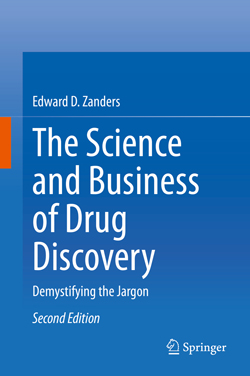
The Science and Business of Drug Discovery-demystifying
the jargon (
Springer
Nature link) is written for those who want to
learn about the biopharmaceutical industry and its products whatever
their level of technical knowledge. Its aim is to demystify the
jargon used in drug development, but in a way that avoids over
simplification and the resulting loss of key information. Each of
the twenty chapters is illustrated with figures and tables which
clarify some of the more technical points being made. Also included
is a drug discovery case history which draws the relevant material
together into a single chapter. In recognizing that it is difficult
to navigate through the many external resources dealing with drug
development, the book has been written to guide the reader towards
the most appropriate information sources, including those listed in
the two appendices.
The following topics are covered:
Different types of drugs: from small molecules to stem cells
Background to chemistry of small and large molecules
Historical background to drug discovery, pharmacology and
biotechnology
The drug discovery pipeline: from target discovery to marketed
medicine
Commercial aspects of drug discovery
Challenges to the biopharmaceutical industry and its responses
Material of specific interest to technology transfer executives,
recruiters and pharmaceutical translators
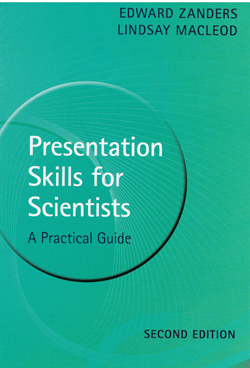
The material used for the now discontinued
Presentation Skills
for Scientists course is available in
Presentation
Skills for Scientists-a Practical Guide by Edward
Zanders and Lindsay MacLeod. The second edition is published by
Cambridge University Press (
CUP
link) and summarised below:
Focuses on practical tips for preparation and delivery without
dwelling on theory, giving the busy reader quick access to the most
useful points
Based on the authors' more than ten years of experience in
delivering practical presentation skills training to scientists, it
provides a succinct guide delivered in a fresh, friendly manner and
with humour
Supplementary video clips illustrate exercises to control nerves and
improve delivery, providing the reader with the tools to enhance
their performance